A Structural Reading of an Apocalyptic Text
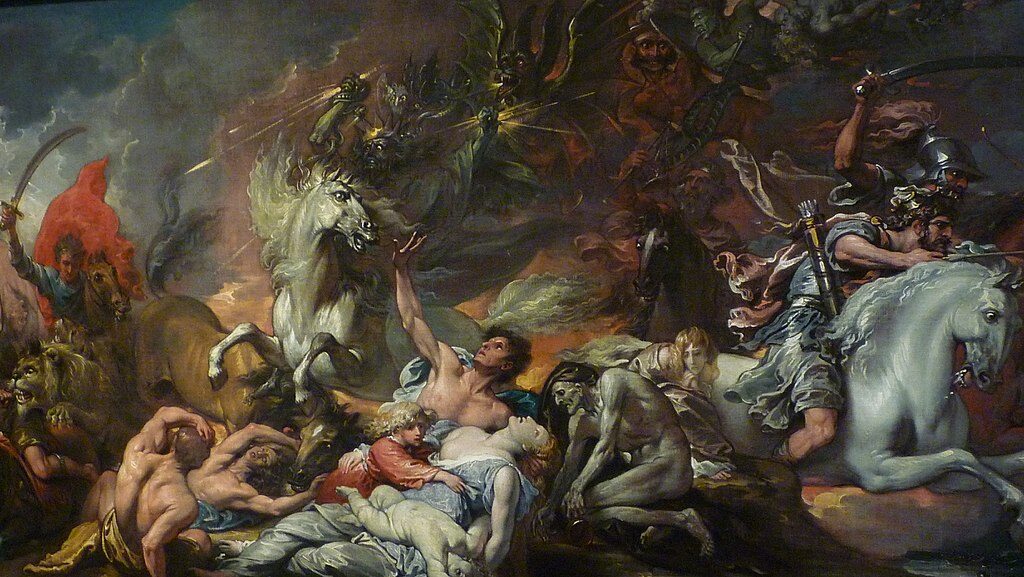
I’m not interested in the Book of Revelation as divine prophecy or a supernatural prediction of the end of the world. I’m interested in it as a text that keeps waking up.
For nearly two thousand years, people have looked at Revelation and concluded that this moment — theirs — must be what it was really about. Roman persecutions. The fall of empires. Plague years. Religious wars. World wars. Nuclear standoffs. Climate collapse. Each generation reads the same visions and feels an unsettling recognition. And each is later told it was mistaken.
At some point, that pattern stops looking like coincidence.
The usual explanations only go so far. Yes, the imagery is elastic. Yes, people turn apocalyptic under pressure. But that doesn’t explain why this particular text keeps resurfacing — why it continues to feel less like an artifact and more like a mirror when history tightens.
What if Revelation was never meant to predict a final ending at all?
What if it was written to describe a recurring phase — a recognizable descent that societies pass through when confidence curdles into conflict, abundance into scarcity, and structure into collapse? Read this way, the Four Horsemen are not future horrors waiting at the end of time. They’re conditions that return in sequence.
This shifts the question from When will it end? to something quieter and harder to answer: What, exactly, was the text hoping we would learn to recognize — and what kind of ending it was really pointing toward?
Why a cyclical reading is reasonable
Before getting into specific historical models, it’s worth pausing on a simpler question: what kind of text is Revelation, actually?
Revelation belongs to a genre known as apocalyptic literature, which flourished in periods of imperial pressure and social instability. These texts weren’t written primarily as calendars of future events. They were written to make sense of lived crisis — to give symbolic shape to experiences of domination, moral inversion, scarcity, and collapse.
Crucially, apocalyptic texts tend to be recursive rather than linear. Revelation itself cycles repeatedly through visions of breakdown and renewal — the seals, the trumpets, the bowls — each sequence retelling the same descent at a deeper or more intense level. The world seems to “end” more than once, only to reappear and unravel again.
That structure alone makes a purely one-time, literal reading hard to sustain.
There’s also the historical fact that Revelation has been re-read as present tense by generation after generation. Each wave of readers wasn’t simply guessing wildly; they were recognizing familiar conditions each time. The text kept lining p with lived experience closely enough to remain compelling throughout two millennia.
Taken together, this suggests a more grounded possibility: that Revelation is describing a pattern of civilizational stress, not a single terminal event.
If that’s the case, then its power lies less in prediction and more in recognition.
Strauss–Howe and historical cycles
With that in mind, it’s interesting to note a modern framework that also describes history as moving through recurring phases of order and breakdown: Strauss–Howe generational theory.
Very briefly, Strauss–Howe proposes that societies tend to cycle through four broad periods:
- a High, marked by confidence and institutional legitimacy
- an Awakening, where values fracture and authority is challenged
- an Unraveling, characterized by cynicism, inequality, and erosion of trust
- and a Crisis, when systemic failures converge and everything is forced into resolution
Whether or not one accepts this model in full, it’s hard not to notice a familiar rhythm here — one that shows up repeatedly in historical records.
What’s striking is that the Four Horsemen of the Apocalypse describe a sequence that looks uncannily similar:
- a rider associated with conquest and authority
- followed by one who takes peace and turns people against each other
- followed by scarcity and economic imbalance
- followed by death through compounded breakdown
I’m not suggesting that the author of Revelation somehow anticipated modern historical theory, or that Strauss–Howe “explains” biblical prophecy. That would be an unnecessary and unhelpful claim.
A simpler explanation is enough:
both may be noticing the same underlying pattern, separated by centuries and expressed in very different symbolic languages.
One uses myth and vision.
The other uses sociology and history.
If that’s true, then Revelation’s persistence starts to make sense. It isn’t that the text keeps failing to predict the end of the world. It’s that it keeps reappearing at moments when the same pressures — confidence, fracture, scarcity, collapse — are cycling through again.
Which brings us, finally, to the Horsemen themselves.
The Four Horsemen as a recurring historical sequence
The Four Horsemen appear with the opening of the first four seals in Book of Revelation (Revelation 6). What follows is a simple observation: each rider describes a condition that societies repeatedly experience under stress — and they appear in a specific order.
I’ll quote briefly, then interpret conservatively.
I. The White Horse — Order, legitimacy, expansion
(Comparable to a historical “High”)
“And I saw, and behold a white horse:
and he that sat on him had a bow;
and a crown was given unto him:
and he went forth conquering, and to conquer.”
— Revelation 6:2
This first rider is often assumed to be righteous or victorious — and the text doesn’t immediately contradict that impression.
- White suggests purity or legitimacy
- A crown was given — authority is conferred, not seized
- Conquest without immediate bloodshed — expansion under confidence
Nothing is visibly wrong yet. The system is winning.
Read historically, this resembles periods when institutions feel:
- justified
- coherent
- morally certain
- outwardly successful
These are the moments that later generations often remember as stable or golden — even though they quietly plant the seeds of what follows.
II. The Red Horse — Fracture, conflict, moral polarization
(Comparable to an “Awakening”)
“And there went out another horse that was red:
and power was given to him that sat thereon
to take peace from the earth,
and that they should kill one another:
and there was given unto him a great sword.”
— Revelation 6:4
The key phrase here is “that they should kill one another.”
This is not invasion.
It’s internal conflict.
- Peace is removed, not replaced by order
- Violence turns inward
- Moral certainty hardens into opposition
Historically, this matches periods when shared narratives break down:
- religious schisms
- ideological revolutions
- culture wars
- moral absolutism on all sides
The system still exists — but coherence fractures.
III. The Black Horse — Scarcity, inequality, transactional life
(Comparable to an “Unraveling”)
“And I beheld, and lo a black horse;
and he that sat on him had a pair of balances in his hand.
… A measure of wheat for a penny,
and three measures of barley for a penny;
and see thou hurt not the oil and the wine.”
— Revelation 6:5–6
This is one of the most concrete images in the text.
- Balances → everything becomes transactional
- Inflated prices → survival grows precarious
- Oil and wine spared → elites remain insulated
The system still functions — but badly, and unfairly.
Trust erodes. Institutions hollow out.
People retreat into private survival strategies.
This is not collapse yet.
It’s decay with a price tag.
IV. The Pale Horse — Systemic breakdown and mass death
(Comparable to a “Crisis”)
“And I looked, and behold a pale horse:
and his name that sat on him was Death,
and Hell followed with him.
And power was given unto them
over the fourth part of the earth,
to kill with sword, and with hunger,
and with death, and with the beasts of the earth.”
— Revelation 6:8
Here, everything converges.
- Violence
- Hunger
- Disease
- Social breakdown
The text no longer distinguishes causes.
Failure compounds across systems.
This is what historical Crises look like from the inside:
- war
- famine
- institutional collapse
- centralized power
- existential stakes
Importantly, this is not the end of history — it’s the point at which history is forced to resolve.
New Jerusalem: a dream of ending the cycle
After the Horsemen have ridden — after conquest, fracture, scarcity, and collapse — Revelation does something unexpected. It doesn’t end with annihilation. It ends with a city.
“And I saw the holy city, New Jerusalem, coming down from God out of heaven.”
— Revelation 21:2
The direction, downward, matters. This is not an escape from the world, but a vision descending into it. Whatever New Jerusalem represents, it’s meant to be lived here.
Read through the same structural lens as the Horsemen, New Jerusalem looks less like a literal prediction and more like a utopian image: a dreamed-of condition in which the cycle no longer has to repeat.
Several details support this reading.
The city has no temple, because mediation is no longer necessary. Meaning isn’t bottlenecked through institutions. The gates are never shut, because there is no siege mentality left — no permanent fear of invasion or collapse. And the imagery emphasizes healing, not judgment: “the leaves of the tree were for the healing of the nations.”
This isn’t perfection in the sense of frozen stasis. There are still peoples, still movement, still plurality. What’s gone are the pressures that drive the cycle in the first place — domination, scarcity, and the constant anticipation of violence.
In other words, New Jerusalem reads less like the end of history and more like a hope that history could stop breaking in the same way.
Seen this way, Revelation doesn’t conclude with prophecy fulfilled, but with a question posed in symbolic form:
What would a society look like if it learned to interrupt its own collapse patterns?
That’s a utopian question, not a supernatural one.
And it points toward something quietly actionable. If apocalyptic texts are early attempts at pattern recognition — if they’re trying to teach people how to notice when confidence hardens into coercion, when fracture turns into scarcity, when decay tips into collapse — then awareness itself matters. Pattern literacy matters.
Cycles repeat most reliably when they’re invisible.
From that angle, it’s a shame that Revelation has so often been buried under hysteria, literalism, and end-times obsession. Read as a timetable, it encourages waiting. Read as a pattern, it encourages attention.
Perhaps the text was never meant to tell us when everything ends.
Perhaps it was meant to help us recognize when things are starting to fall apart — and imagine, however imperfectly, how they might not have to.
That’s not prophecy.
It’s a warning — and a hope.